art-culture
Maxfield Parrish: The Painter Behind “Parrish Blue”
Golden lanterns against deep blue, and a dreamlike landscape beyond a pair of columns. How did Maxfield Parrish make his pictures glow? Follow the layered color behind “Parrish Blue” and the journey of his images through books, calendars and art prints.
Round yellow lanterns rise above a flight of steps. Behind the figures in white, the sky is a deep blue. In Maxfield Parrish’s The Lantern Bearers (1908), the painted lanterns seem to give off light.
Where does that glow come from? Looking at the work of American painter and illustrator Maxfield Parrish (1870–1966) helps explain why a shade of blue came to carry his name.
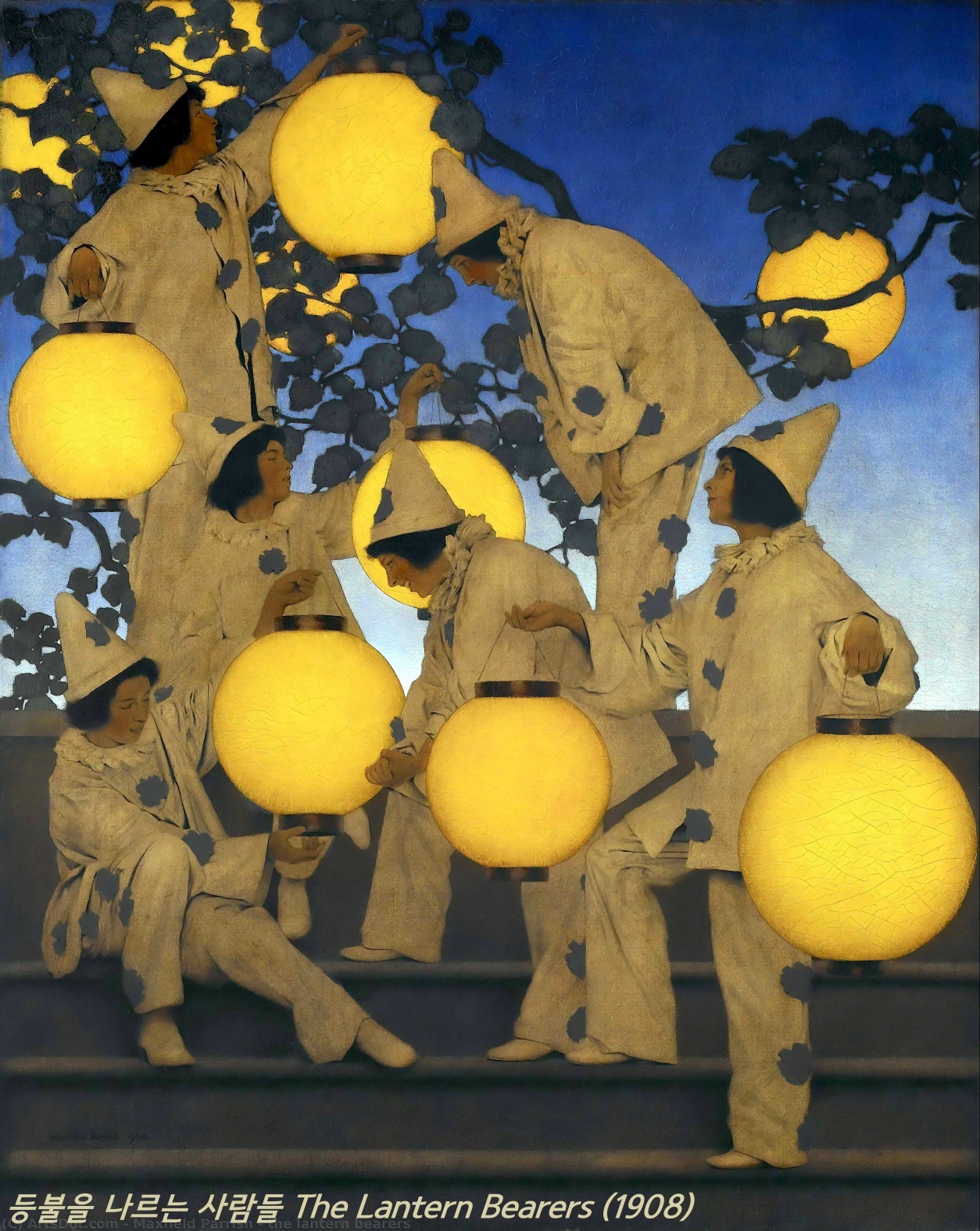
Maxfield Parrish, The Lantern Bearers, 1908. Collection of Crystal Bridges Museum of American Art. Image supplied by the user.
A sky built from more than one layer
His vivid blue became known as ‘Parrish Blue,’ a signature noted by the National Museum of American Illustration. It is the kind of color you might remember before you remember the artist’s name.
The luminous effect involved building up thin layers of color. Layers of oil paint and varnish added depth and sheen, a method known as glazing. Rather than treating Parrish Blue as a single new paint he invented, it is more useful to think of it as the distinctive blue he achieved in his pictures.
Look back at the lanterns. Their yellow light is only part of what catches the eye: the surrounding blue makes it appear more intense. When looking at Parrish’s colors, notice what sits beside each one.
A whole landscape on a book page
Books were another place to encounter his imagined worlds. Parrish illustrated L. Frank Baum’s Mother Goose in Prose, published in 1897, as well as The Arabian Nights (1909) and The Knave of Hearts (1925).
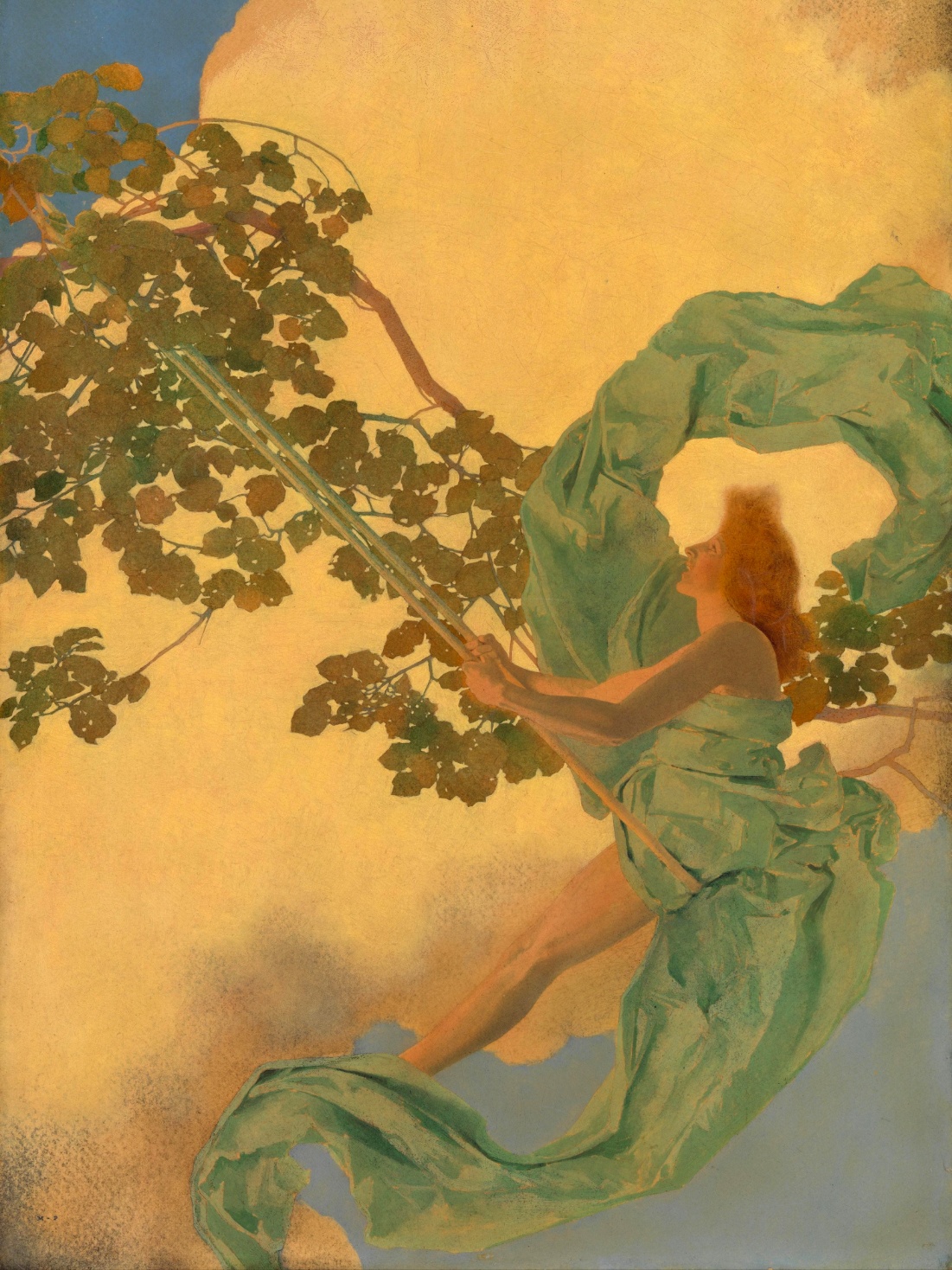
Maxfield Parrish, Princess Parizade Bringing Home the Singing Tree, 1906. Collection of PAFA. Image supplied by the user.
In Princess Parizade Bringing Home the Singing Tree (1906), a figure reaches toward a branch. The Pennsylvania Academy of the Fine Arts (PAFA) identifies the scene as the princess finding a magical tree in The Arabian Nights. Knowing the story gives the figure a purpose within the golden landscape.
According to PAFA, Collier’s Weekly commissioned Parrish’s Arabian Nights illustrations, which subsequently appeared in books and as commercial prints. A single scene could move from a magazine to a book and then onto a wall.
From printed pages to the walls of a home
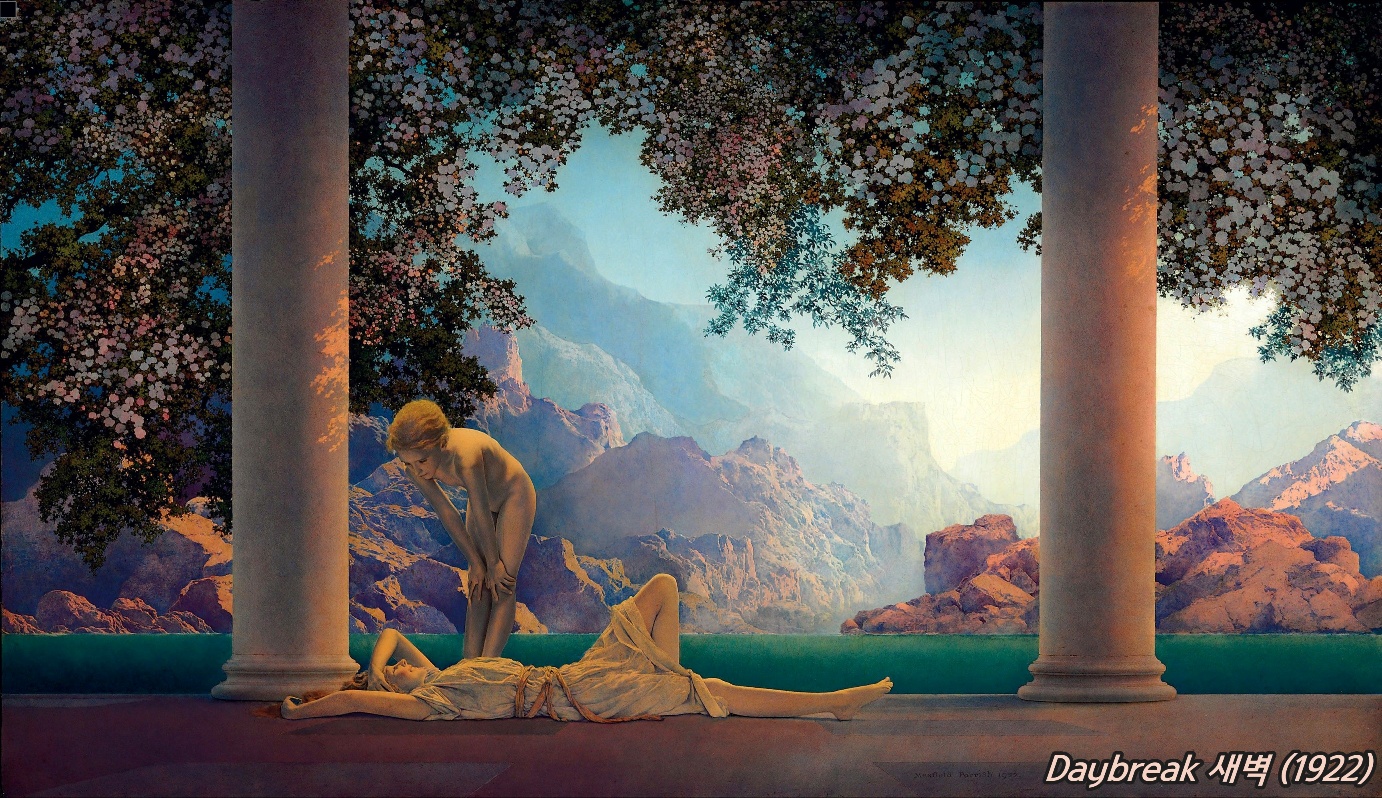
Maxfield Parrish, Daybreak, 1922. Image supplied by the user.
Daybreak (1922), with its figures between columns and its distant mountains and foliage, tells another part of that story. It was conceived specifically for reproduction as an art print. An original painting and the experience of seeing its image in many homes could be part of the same project.
Parrish worked across far more than books. The Flagler Museum’s 2025 exhibition materials describe roughly 900 works spanning book and magazine covers, children’s illustrations, stage sets, stationery and murals. His pictures also appeared on calendars.
The colors and landscapes Parrish made in oil reached a wide audience through print. People could encounter his pictures by opening a book or turning a calendar page, without seeing an original painting.
Swings, bubbles and three ways of looking at the sky
Three more pictures invite a closer look. Similar blues feel different as the direction of a figure and the shape of the clouds change.
The Dinkey Bird: a swing among the clouds
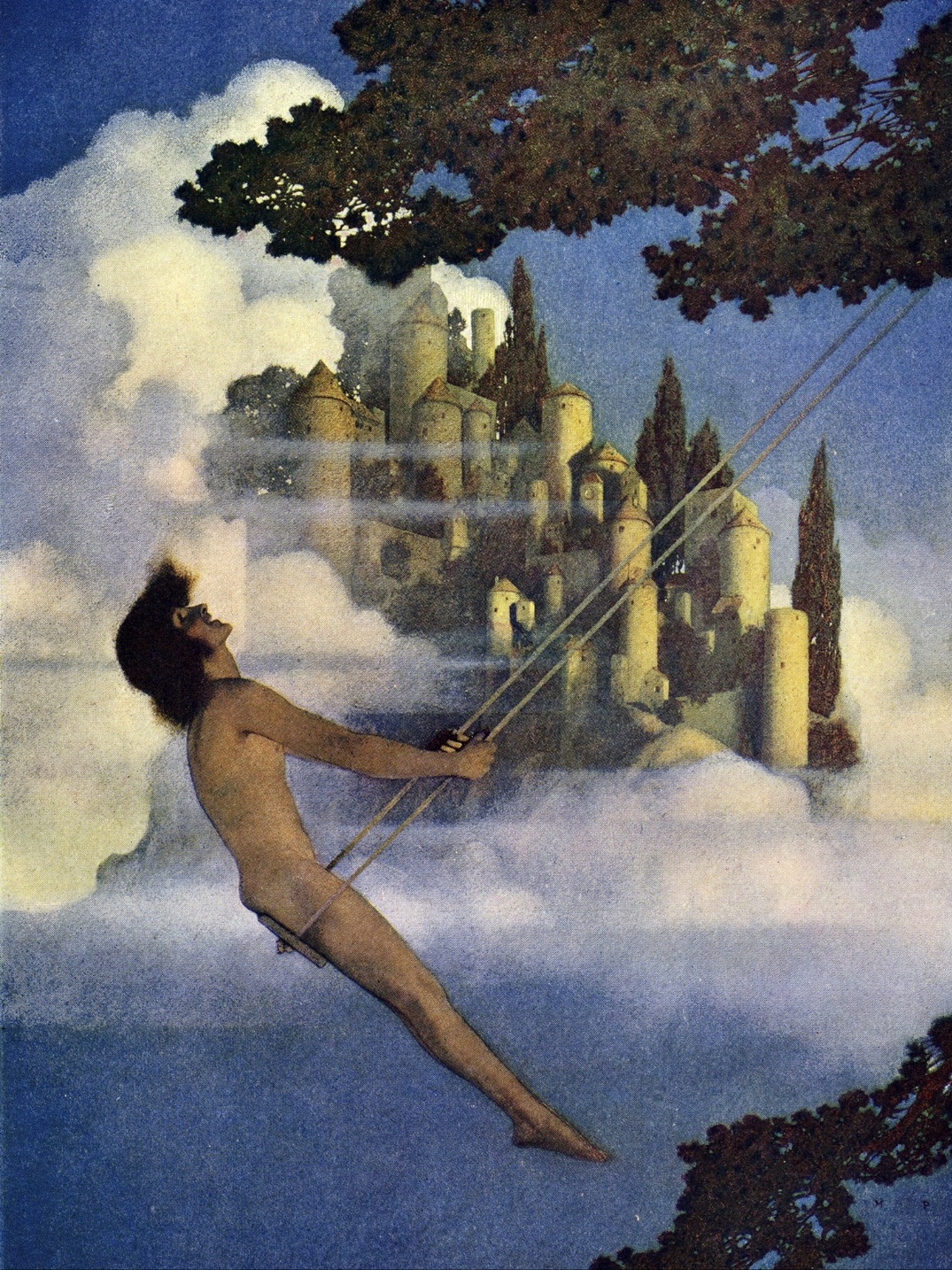
Maxfield Parrish, The Dinkey Bird. Illustration for Poems of Childhood, published in 1904. Collection of the Morse Museum. Image supplied by the user.
The ropes stretch toward the upper right, while the figure’s legs extend down the picture. Behind them, a castle sits among clouds, making the height of the swing difficult to judge. The Morse Museum’s collection entry identifies it as an illustration for Poems of Childhood, published in 1904.
Air Castles: where bubbles and towers overlap
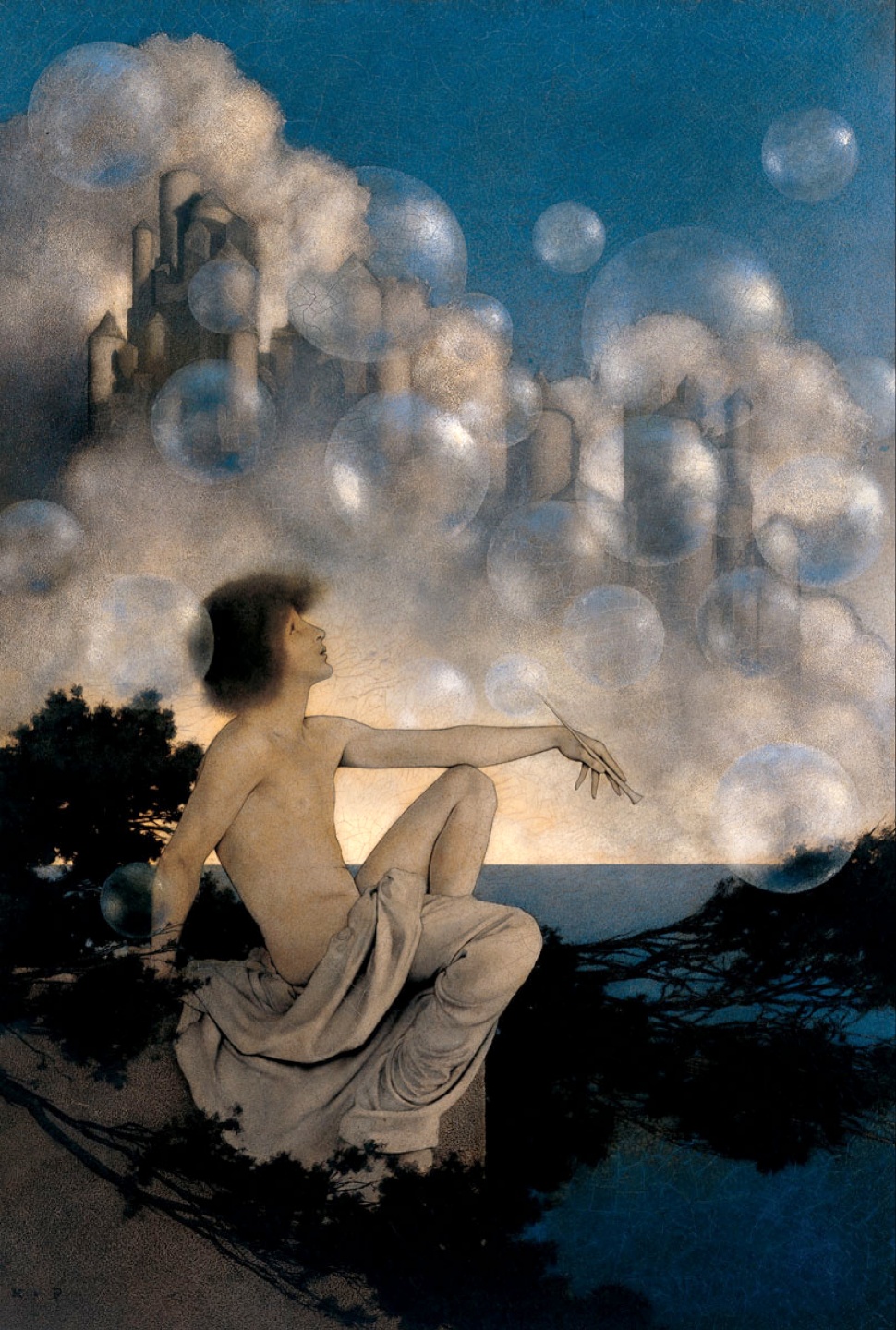
Maxfield Parrish, Air Castles. Used on the September 1904 cover of Ladies’ Home Journal. Image supplied by the user.
Round bubbles float above a seated figure, with castle towers visible beyond them. Solid buildings and seemingly fragile bubbles share the same sky. Haverford College Library’s finding aid records the image as the September 1904 cover of Ladies’ Home Journal.
Ecstasy: blue across sky, fabric and distant mountains
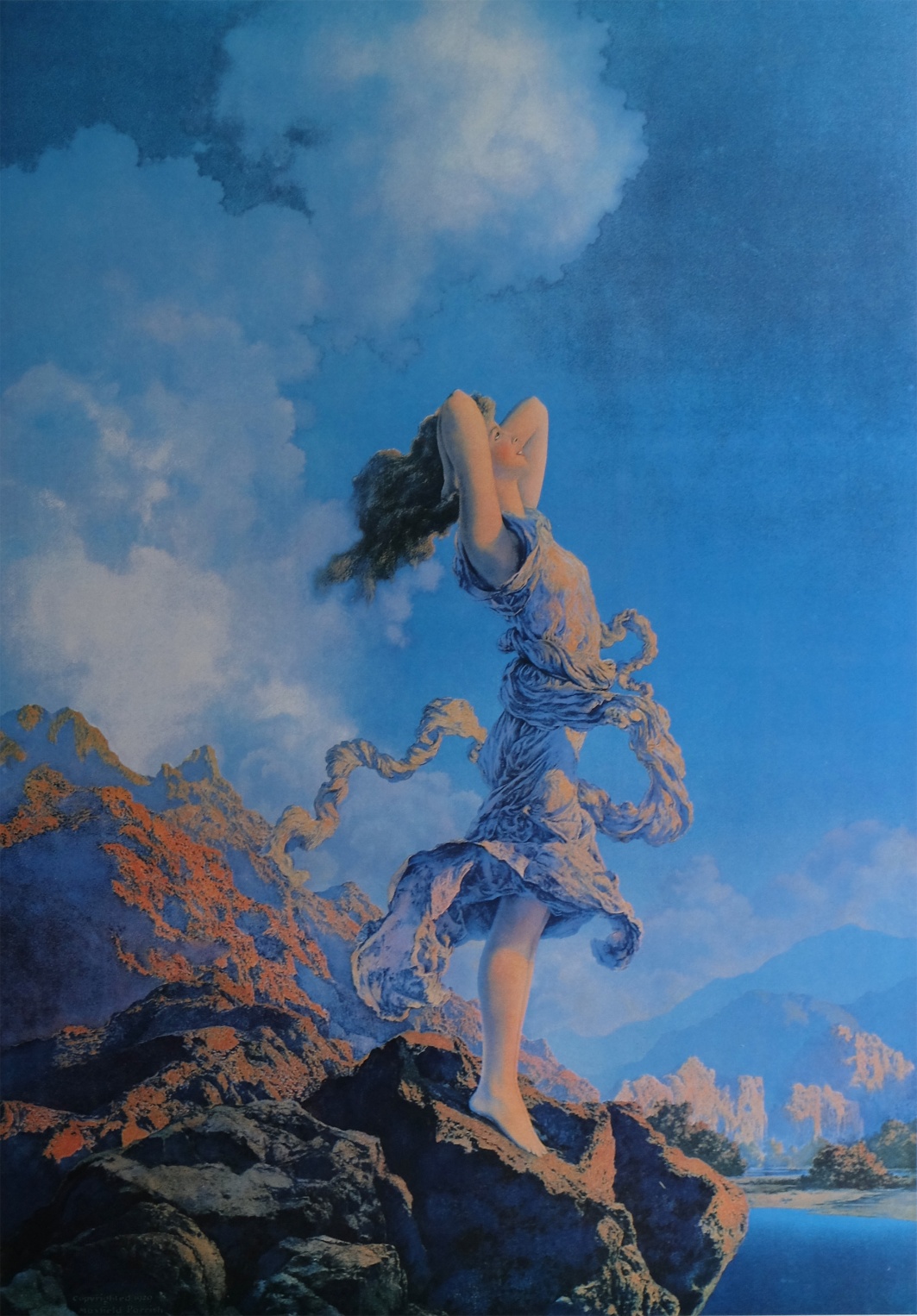
Maxfield Parrish, Ecstasy. Used in the 1930 General Electric Mazda Lamps calendar. Image supplied by the user.
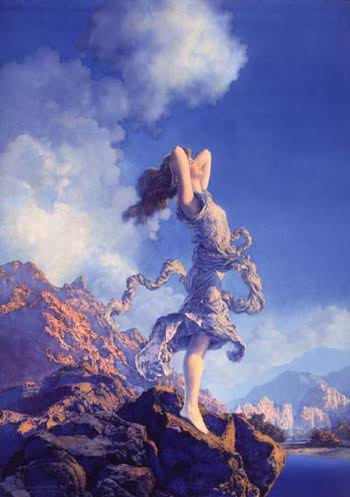
A figure stands on a rock with both arms raised behind the head. The blue of the sky continues through the clothing and distant mountains, divided by the warmer colors of the rocks. The Museum of the Shenandoah Valley’s exhibition materials identify this image with the 1930 General Electric Mazda Lamps calendar.
Return to the yellow lanterns, and the blue behind them comes into focus. Follow the edge of one lantern out into the sky. Where the yellow light ends, Parrish’s blue begins.