art-culture
Did Meomuru earn nothing? Royalties and recording revenue are different
Does “zero royalties” mean Meomuru earned nothing from 〈꿈꾸던 어른이 되었나요?〉? Its producers said they received distribution revenue while not receiving the usual songwriting, composition and arrangement royalties. Their interview and Korea’s Copyright Act help explain the distinction.

A song is attracting listeners on the charts. Does that mean its makers could still receive nothing? The “zero royalties” discussion around Meomuru’s 〈꿈꾸던 어른이 되었나요?〉 begins with identifying which payment is being discussed.
The producers said they were receiving music distribution revenue, even though they were not receiving the usual songwriting, composition and arrangement royalties. Reducing those statements to “no income at all” changes their explanation.
The producers described two different payments
In an interview published by The Korea Economic Daily on October 25, 2026, production team Glorywave said it was not receiving the usual lyric-writing, composition and arrangement royalties. It also said revenue generated through music distribution was being paid normally. The article reported that the song was not registered with the Korea Music Copyright Association at the time.
What this establishes is the producers’ account of payments at that time. The interview did not publish a settlement statement or current account balance, so it does not establish how much they earned.

Glorywave, the production team behind Meomuru. Photo supplied by Glorywave and published in The Korea Economic Daily.
The lyrics, composition and recording are separate things
“Money from a song” can include income arising from different rights and contracts. The law distinguishes the copyright of people who create lyrics and compositions from the rights of a producer of a sound recording.
Songwriting and composition royalties refer to payments for the use of creative works. Music distribution revenue describes income generated by distributing a recording. The producers distinguished these categories in their explanation.
Korea’s Copyright Act separately provides for sound recording producers’ rights of reproduction, distribution and interactive transmission in Articles 78, 79 and 81. Those provisions alone do not establish the contractual revenue split or ownership of individual rights in Meomuru’s case. The absence of one royalty payment does not, by itself, establish the absence of every payment route.
Does non-registration with an association erase copyright?
The creation of copyright, copyright registration and entrusting rights to an association for management are different matters. Article 10(2) of the Copyright Act states that copyright arises upon creation without requiring procedures or formalities. Association registration alone cannot determine whether copyright exists.
Article 2 defines a work in terms of a creative expression of human thoughts or emotions. The use of AI and the expression actually created by a person therefore need to be considered separately. This article does not determine the legal protection of any particular lyric or composition by Meomuru.
A Hankook Ilbo report published on November 19, 2026 stated that the Korea Music Copyright Association was deferring trust registration where applicants did not warrant that AI had not been used. That describes the association’s handling of applications at the time of the report. It should not be expanded into a claim that all AI-assisted music lacks copyright.
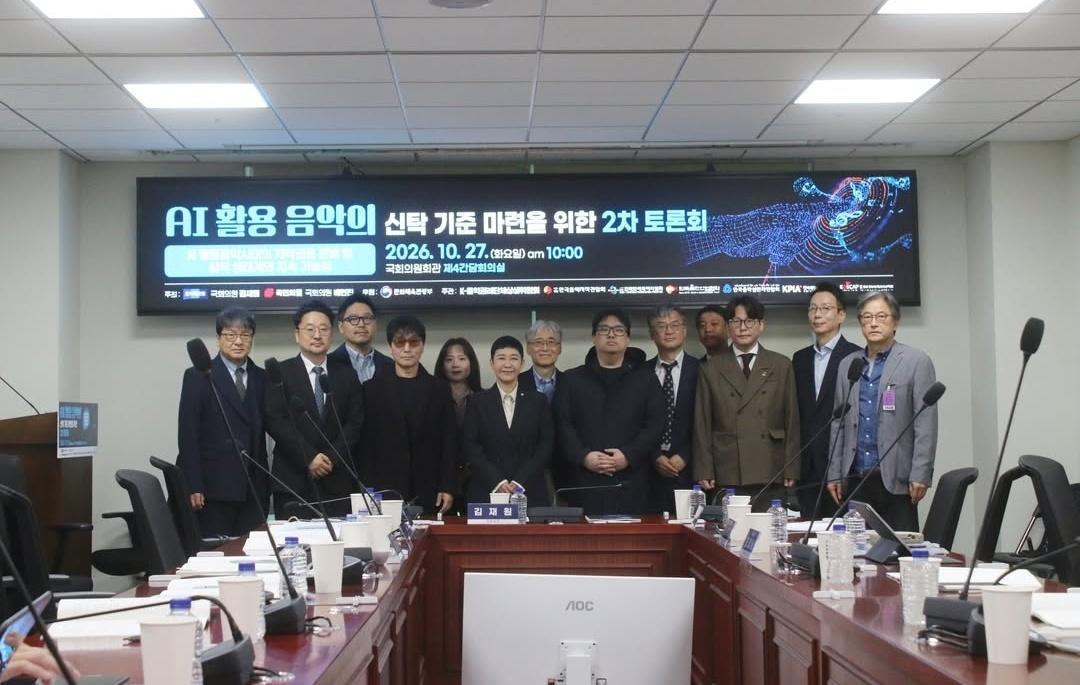
The second discussion on trust registration standards for AI-assisted music, October 27, 2026. Photo supplied by lawmaker Kim Jae-won’s office and published by Hankook Ilbo.
A chart position is not a settlement statement
Listening popularity and money paid are different information. The interview did not disclose a specific settlement amount, contractual revenue split, production costs or net profit. Chart positions alone cannot establish those figures.

Chart material published with the October 2026 interview. It shows neither the current ranking nor revenue records. Source: The Korea Economic Daily.
The interview provides no basis for concluding that Meomuru “did not earn a penny.” Its account is more specific: the producers said they were not receiving the usual lyric-writing, composition and arrangement royalties, but were receiving music distribution revenue.
The income category next to “zero” changes what that number tells us about the same song.
Read the producers’ explanation
The Korea Economic Daily interview was published on October 25, 2026. The original article explains the payment categories distinguished by the producers.