art-culture
David Hockney Has Passed Away. But What Happens to the Value He Created?
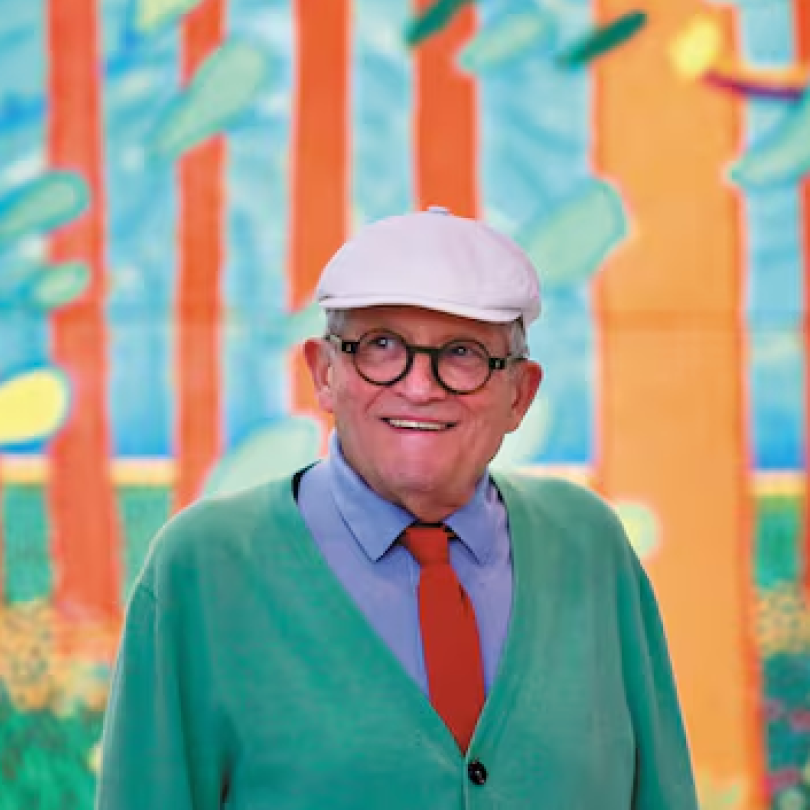

David Hockney Has Passed Away. But What Happens to the Value He Created?
What happens to an artist's value when they are no longer alive to create? This is not just a sentimental question. It is a financial and cultural one — and the death of David Hockney on June 11, 2026, at age 88, makes it impossible to ignore.
Hockney left behind one of the most significant bodies of work of the 20th and 21st centuries. His paintings are held in the world's leading museums. His auction records reach into the tens of millions. And yet the most important thing about his legacy is not what his work sold for — it is how that value was built, and why it will continue to grow now that he is gone.
This is exactly the question YEATU exists to explore: how does creativity become an asset? Hockney is one of the clearest case studies we have.
Value Is Built, Not Just Inherited
Hockney's market value was not simply a product of talent. It was constructed over decades through a deliberate and consistent creative ecosystem. Born in Bradford, Yorkshire in 1937, he decided at age 11 that he wanted to be an artist. He trained at Bradford College of Art and then the Royal College of Art in London, where he quickly distinguished himself as one of the most exciting painters of his generation.
In the early 1960s, he arrived in Los Angeles and encountered a city that would reshape his practice entirely. The sharp Californian light, so unlike the grey of northern England, freed him to use color with a boldness that felt entirely new. The swimming pool became his great subject — a symbol of leisure and optimism, but also a technical obsession with how light moves across water and surface. Works like A Bigger Splash didn't just capture a place; they invented a visual language that became instantly recognizable worldwide.

But recognition alone does not create lasting financial value. What drove Hockney's work into the tens of millions at auction was the ecosystem that formed around it: decades of museum acquisitions, major retrospectives, institutional scholarship, collector demand across multiple continents, and consistent authentication and preservation of his output. Each layer reinforced the next. Museums validated collectors. Collectors funded further scholarship. Scholarship deepened cultural significance. Cultural significance attracted new audiences and new buyers.
This is the process YEATU traces across the creative economy — the way cultural assets accumulate value not through a single transaction, but through the sustained attention of institutions, markets, and audiences over time.
Six Decades Without Going Quiet
What made Hockney unusually valuable was his ability to sustain this ecosystem across an extraordinarily long career. Throughout his life, he worked across painting, drawing, printmaking, photography, and stage design. He never allowed his practice to calcify. In his later years, he embraced iPad technology to produce large-scale landscape works, attracting a fresh audience while holding onto the last — a sign of genuine cultural influence, not just historical reputation.
In his later decades, he returned frequently to the landscapes of his Yorkshire childhood, painting the seasons and hedgerows of the East Riding in vivid, monumental works. He divided his time between England, France, and California. Each chapter of his life produced a distinct body of work, and each body of work found its own collectors, its own critical reception, and its own institutional home.
That universality is what made Hockney's work a genuinely global asset class rather than a regional or period curiosity.

What Happens Now
When an artist dies, the supply of new work permanently closes. But demand, where it has been properly built, does not close with it. It often intensifies.
Hockney's estate and foundation will now take on the work of stewarding his legacy: authenticating works, managing the archive, authorizing reproductions, and supporting scholarship. These are not merely administrative functions. They are the mechanisms through which artistic value is preserved and grown after the creator is gone. Estate management, foundation governance, and archival integrity are the infrastructure of long-term cultural value — and they matter as much to the financial trajectory of an artist's work as any auction result.
What was already scarce becomes permanently finite. And when the world has spent decades affirming the significance of an artist's body of work through museums, critics, collectors, and institutions, buyers are not simply purchasing objects. They are acquiring a piece of cultural history whose importance has already been established and is unlikely to diminish.
Hockney shows us that art value is not created only when an artwork is sold. It is built through recognition, preservation, and the cultural ecosystems that allow creativity to continue beyond the creator. His life's work is now, in the most literal sense, a permanent asset — and understanding how that asset was built is precisely what YEATU is here to explore.
Beyond appreciating art, discover a new way to see its value.
Explore new possibilities in art with YEATU.
🎁 Sign up today and receive 5,000 KRW ➕ Enter referral code EPPQ3618 for an additional 2,000 KRW reward